

USD 1.93 Billion E-House Market Expected to Hit USD 3.34 Billion by 2035
E-House Market
E-House Market Size, Share and Research Report By Solution (Fixed E-House, Mobile Substation), By Voltage Rating (Low Voltage, Medium Voltage, High Voltage)
E-House Market is gaining momentum due to increasing investments in power distribution infrastructure, industrial automation, and modular electrical solutions across energy and manufacturing sectors.”
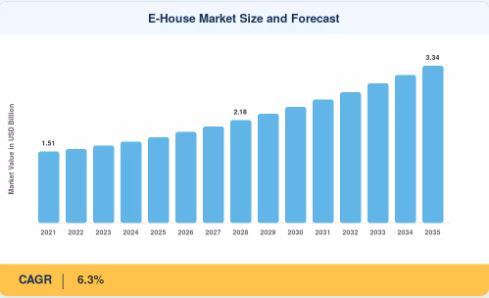
NEW YORK,, NY, UNITED STATES, July 31, 2026 /EINPresswire.com/ -- The Global E-House market was valued at USD 1.82 billion in 2025 and is projected to reach USD 1.93 billion in 2026 before climbing to USD 3.34 billion by 2035, registering a CAGR of 6.3% during the 2026–2035 forecast window. Accelerating grid modernization programs particularly the US Department of Energy's USD 20 billion Grid Resilience and Innovation Partnerships initiative and the European Union's revised Trans-European Networks for Energy regulation are channeling capital toward factory-assembled electrical enclosures that compress project timelines from twelve months to as few as eight weeks. Utilities, mining operators, and data-center developers increasingly prefer these pre-engineered modules because they reduce field labor, minimize safety incidents, and deliver pre-commissioned power distribution in a single truck-ready package, with grid modernization and resilience mandates (~1.4% CAGR impact), data-center power demand surge (~1.2%), and the SF₆ phase-out and digital switchgear transition (~0.9%) standing out as the highest-impact growth drivers.— Market Research Future (MRFR)
The market is undergoing a bigger technology transformation. Traditional stick-built substations and field-fabricated switchgear rooms are being replaced by integrated modular units that bring together medium-voltage switchgear, low-voltage distribution panels, transformers, and digital protection relays in one weather-rated enclosure. The pending phase-out of sulfur hexafluoride insulation gas under the EU F-Gas Regulation revision is accelerating adoption of vacuum and clean-air switchgear inside these modules, with an estimated USD 1.2 billion in retrofit spending expected across European utilities by 2030.
Asia-Pacific leads the market with around 35% of worldwide revenue share, driven mostly by the ultra-high-voltage corridor build-out in China and the Revamped Distribution Sector Scheme in India. The Middle East & Africa is the fastest-expanding market with a predicted CAGR of 10.2% through 2035, driven by Saudi Arabia's NEOM and Red Sea megaprojects, while North America is the second-largest region at around 24%, aided by data-center campus expansions and renewable-energy connectivity backlogs.
Get Full PDF Sample Copy of Report: (Including Full TOC, List of Tables & Figures, Chart) @
https://www.marketresearchfuture.com/sample_request/5576
➤ How Significant Is the E-House Market's Growth?
The E-House market's trajectory from USD 1.93 billion in 2026 to a projected USD 3.34 billion by 2035 represents nearly a 1.8-fold expansion over the forecast decade, reflecting the structural shift from field-built substations and switchgear rooms toward factory-assembled, pre-commissioned modular enclosures as the preferred standard across utilities, industrial, and data-center applications. The market's 6.3% CAGR is anchored in a convergence of grid-resilience funding, hyperscale power-demand growth, and regulatory phase-outs that are together pulling procurement toward modular, weather-rated solutions.
Fixed E-House units accounted for approximately 58% of 2025 revenue, reflecting strong utility and industrial preference for permanent installations, while Mobile Substations are expanding at a 6.6% CAGR through 2035, driven by emergency restoration and temporary power needs.
Medium-voltage configurations remain the backbone of the market, serving 6.6–36 kV distribution needs, while High Voltage units are growing fastest at an 8.2% CAGR as renewable-energy developers co-locate step-up substations with wind and solar farms. Utilities commanded roughly 53% of 2025 revenue, underpinned by grid-expansion mandates, while Data Centers represent the fastest-growing application segment at an 8.8% CAGR as hyperscale operators pre-commission identical power blocks across campus locations. Switchgear leads by component with approximately 46% share, while Protection & Control Systems are the fastest-growing component category at a 9.0% CAGR amid IEC 61850 digitalization.
➤ What Does the Future Hold for the E-House Market?
Grid modernization and resilience mandates are the single highest-impact driver, contributing approximately 1.4 percentage points to the market's CAGR. The US GRIP program alone allocates USD 10.5 billion to grid hardening, with a significant portion targeting modular substation solutions that can be deployed in weeks rather than months, while Canada's Smart Renewables and Electrification Pathways program adds CAD 964 million for grid upgrades through 2028. These programs explicitly prioritize factory-tested, pre-commissioned equipment to reduce field risk a specification that directly benefits the E-House market.
Data-center power demand surge contributes approximately 1.2 percentage points to the CAGR: global data-center electricity consumption is projected to exceed 1,000 TWh by 2030 according to the IEA, and hyperscale operators such as Amazon Web Services and Microsoft require rapid, repeatable power-delivery modules that match the pace of server-rack deployment, cutting energization timelines from 14 months to under 16 weeks.
The SF₆ phase-out and digital switchgear transition adds a further 0.9 percentage points, as the European Commission's revised F-Gas Regulation targets a complete ban on SF₆ in new medium-voltage switchgear by 2030, affecting an installed base valued at over EUR 4 billion and creating a sustained replacement cycle. Mining and oil-gas electrification contributes approximately 0.8 percentage points, as the International Council on Mining and Metals estimates mine electrification could reduce sector emissions by 30% by 2040, with remote sites in Australia, Chile, and sub-Saharan Africa increasingly relying on containerized e-houses where traditional construction is impractical.
The IEA's World Energy Outlook 2024 projects global electricity demand to rise by 75% between 2023 and 2050, and every new gigawatt of generation or storage capacity requires switchgear, transformers, and protection systems the core components housed inside e-houses a structural tailwind expected to sustain the market well beyond 2035. Embedded sensor arrays and edge-computing controllers are transforming e-houses from passive enclosures into intelligent nodes, with predictive analytics able to forecast busbar hotspot failures 72 hours in advance and reduce unplanned downtime by up to 40%, while digital procurement platforms are compressing sales cycles from six months to six weeks and expanding access to mid-tier buyers.
Get access to the full description of the report @
https://www.marketresearchfuture.com/reports/e-house-market-5576
➤ Who Are the Key Players in the E-House Market?
The E-House market has medium concentration, with the top five vendors contributing an estimated 38–45% of global revenue and a Herfindahl-Hirschman Index in the 800–1,200 range, indicating a competitive but not fragmented landscape. Regional fabricators in the Middle East and Asia-Pacific exert price pressure on global OEMs, driving the latter toward value-added digital integration and full-turnkey service models. MRFR identifies the following key participants with estimated revenue share ranges:
ABB Ltd. (~8–11% share) - the global full-portfolio leader offering MV/HV modular substations and digital switchgear, with a modular-solutions portal that streamlines configuration and procurement.
Siemens Energy (~7–10% share) - a European technology leader providing NXAIR+ switchgear and gas-insulated modules positioned to meet the region's F-Gas Regulation compliance deadlines.
Schneider Electric (~6–9% share) - a digital-integration specialist offering EcoStruxure-enabled modular enclosures and an online configurator that compresses sales cycles from months to weeks.
Eaton Corporation (~5–8% share) - a data-center specialization leader providing power-distribution assemblies and UPS modules; it introduced a containerized power-distribution unit purpose-built for 50 MW data-center blocks in June 2024, cutting energization lead time to 12 weeks.
Powell Industries (~3–5% share) - a North American niche leader offering custom-engineered medium-voltage switchgear houses tailored to utility and industrial specifications.
WEG S.A. (~2–4% share) - a South American price-performance leader offering transformer-integrated e-houses suited to the region's mining and renewables projects.
Aktif Elektroteknik (~2–4% share) - a Turkish export hub providing compact medium-voltage and low-voltage modules to markets across Europe, the Middle East, and Africa.
TGOOD Electric (~2–3% share) - a Chinese domestic and Belt and Road-focused provider of prefabricated modular substations supporting China's UHV corridor build-out.
Delta Star Inc. (~1–3% share) - a utility emergency-response specialist providing mobile transformer substations for storm restoration and planned maintenance outages.
Elgin Power Solutions (~1–2% share) - an oil-gas and mining applications provider offering skid-mounted power centers suited to remote and containerized deployments.
Strategic competition in the E-House market is increasingly defined by digital-twin and IoT-integration depth, SF₆-free switchgear readiness, regional fabrication cost advantages, and the pace at which vendors can shift from one-time hardware sales toward turnkey, service-annuity business models.
➤ What Are the Emerging Trends in the E-House Market?
Several transformational trends are redefining the E-House market's evolution through 2035:
AI-Enabled Predictive Operations: Embedded sensor arrays and edge-computing controllers are transforming e-houses from passive enclosures into intelligent nodes, with predictive analytics able to forecast busbar hotspot failures 72 hours in advance and reduce unplanned downtime by up to 40%.
Modular Hydrogen Electrolysis Plants: Green-hydrogen projects from NEOM to Rotterdam require dedicated medium-voltage power-distribution hubs that pair well with containerized e-house designs, with the Hydrogen Council estimating USD 700 billion in cumulative hydrogen investment by 2030.
Emerging-Market Grid Access Programs: Sub-Saharan Africa's electricity access rate stands at only 51%, and national electrification roadmaps in Nigeria, Kenya, and Ethiopia are specifying modular substations for rural distribution, opening a new demand corridor.
Drone-Based Inspection and Digital Twin Integration: Coupling e-house modules with real-time monitoring platforms and digital twins allows predictive maintenance that cuts unplanned outages by up to 35%, giving OEMs that bundle embedded IoT sensors a service-revenue annuity beyond initial hardware sale.
Circular-Economy Retrofit and Redeployment Models: Lease-and-redeploy business models for temporary and relocatable e-houses reduce waste and lower total cost of ownership, with oil-and-gas operators already rotating modules between wellpad sites a model extending to mining, construction, and disaster recovery.
ESG and Sustainability Reporting Pressure: Scope 3 reporting frameworks under the EU Corporate Sustainability Reporting Directive require infrastructure developers to document embodied carbon, and factory-assembled e-houses produce a verifiable carbon footprint 20–30% lower than equivalent field-built structures.
Buy Full Research Report:
https://www.marketresearchfuture.com/checkout?currency=one_user-USD&report_id=5576
➤ How Is the E-House Market Segmented?
The E-House market report provides a comprehensive segmentation framework:
By Solution: Fixed E-House (~58% share, 2025), Mobile Substation (~6.6% CAGR)
By Voltage Rating: Low Voltage (~USD 0.33 Billion, 2025), Medium Voltage (~60% share, 2025), High Voltage (~8.2% CAGR)
By Application: Utilities (~53% share, 2025), Industrial (~USD 0.22 Billion, 2025), Oil and Gas (~6.9% CAGR), Mining (~8% share, 2025), Data Centers (~8.8% CAGR), Others Renewables, Hydrogen, Rail (~USD 0.07 Billion, 2025)
By Component: Switchgear (~46% share, 2025), Transformer (~USD 0.51 Billion, 2025), Protection & Control Systems (~9.0% CAGR), Others Busbar, HVAC, Fire Suppression (~10% share, 2025)
By Deployment Mode: Permanent (~73% share, 2025), Temporary / Relocatable (~6.5% CAGR)
By Region: Asia-Pacific (~35% share, 2025), North America (~24% share, 2025), Europe (~22% share, 2025), Middle East & Africa (~10.2% CAGR), South America (~8% share, 2025)
➤ What Are the Regional Insights from the E-House Market?
Asia-Pacific leads the E-House market with around 35% of 2025 revenue, with China commanding approximately 42% of regional revenue through ultra-high-voltage grid corridors and renewables build-out State Grid Corporation commissioned over 40 modular substation projects along UHV corridors in 2024. India is expanding at an 8.5% CAGR through the Revamped Distribution Sector Scheme and solar-park substations targeting smart-metered distribution upgrades across 250 million households, while Japan, South Korea, and ASEAN contribute through post-Fukushima grid-resilience reforms, semiconductor fab power systems, and industrial-zone electrification respectively.
North America is the second-largest region at around 24% of 2025 revenue, with the United States commanding approximately 72% of regional revenue through GRIP funding and hyperscale data centers US utilities filed over 2,600 GW of interconnection requests in 2023 alone, and modular e-houses are the preferred solution for rapid substation construction at solar and wind collection points. Canada is growing at a 6.8% CAGR through critical-mineral mining in Ontario and Québec, while Mexico contributes through nearshoring manufacturing clusters.
Europe holds approximately 22% of 2025 revenue, tightly linked to the F-Gas Regulation timeline mandating SF₆-free medium-voltage switchgear in new installations by 2030. Germany commands approximately 26% of regional revenue through the Energiewende and industrial decarbonization, with German TSOs earmarking EUR 25 billion for grid expansion through 2030 under the Netzentwicklungsplan, while the UK, France, Italy, Spain, Nordic countries, and Russia contribute through offshore wind grid connections, nuclear fleet refurbishment, renewable energy auction pipelines, solar PV interconnection, data-center corridor expansion, and oil-gas upstream electrification respectively.
The Middle East & Africa is the fastest-growing region at a 10.2% CAGR through 2035, with Saudi Arabia holding approximately 34% of regional revenue through the NEOM and Red Sea Project, part of a Vision 2030 infrastructure pipeline exceeding USD 1 trillion in planned spending. The UAE is expanding at a 9.8% CAGR through industrial diversification and solar parks, while South Africa and Egypt contribute through Eskom unbundling and mining, and Suez Canal Economic Zone development respectively. South America represents approximately 8% of 2025 revenue, with Brazil commanding 52% of regional revenue through pre-salt offshore and solar farms, and Chile and Peru which together account for over 40% of global copper output replacing diesel gensets with grid-connected modular e-houses to meet national decarbonization pledges.
➤➤➤ Regional & Country-Level Reports by Market Research Future:
US E-House Market -
https://www.marketresearchfuture.com/reports/us-e-house-market-13594
➤➤➤ Related Reports by Market Research Future:
Electronic Toy Market
https://www.marketresearchfuture.com/reports/electronic-toy-market-36101
Enterprise Asset Leasing Market
https://www.marketresearchfuture.com/reports/enterprise-asset-leasing-market-24423
Facial Recognition Payment Market
https://www.marketresearchfuture.com/reports/facial-recognition-payment-market-31403
Financial Protection Market
https://www.marketresearchfuture.com/reports/financial-protection-market-33169
Fintech Lending Market
https://www.marketresearchfuture.com/reports/fintech-lending-market-22833
Forex Prepaid Card Market
https://www.marketresearchfuture.com/reports/forex-prepaid-card-market-24849
General Insurance Market
https://www.marketresearchfuture.com/reports/general-insurance-market-31404
Ground Investigation Market
https://www.marketresearchfuture.com/reports/ground-investigation-market-35865
Hdmi Switch Market
https://www.marketresearchfuture.com/reports/hdmi-switch-market-22502
Hospital Logistics Robot Market
https://www.marketresearchfuture.com/reports/hospital-logistics-robot-market-35060
Sagar Kadam
Market Research Future
+ + +1 628-258-0071
email us here
Legal Disclaimer:
EIN Presswire provides this news content "as is" without warranty of any kind. We do not accept any responsibility or liability for the accuracy, content, images, videos, licenses, completeness, legality, or reliability of the information contained in this article. If you have any complaints or copyright issues related to this article, kindly contact the author above.
