

Feed Enzymes Market to Hit USD 2.38 Billion by 2034, Growing at 5.45% CAGR (2026–2034)
Feed Enzymes Market size
Global feed enzymes market valued at USD 1.49 billion in 2025 is projected to reach USD 2.38 billion by 2034, growing at a CAGR of 5.45%.
The feed enzymes market is set to grow from USD 1.49 billion in 2025 to USD 2.38 billion by 2034, driven by rising demand for high-quality animal feed and sustainable nutrition.”
PUNE, MAHARASHTRA, INDIA, February 5, 2026 /EINPresswire.com/ -- The global feed enzymes market size was valued at USD 1.49 billion in 2025 and is projected to grow from USD 1.56 billion in 2026 to USD 2.38 billion by 2034, exhibiting a CAGR of 5.45% during the forecast period. Asia Pacific dominated the global market with a share of 34.51% in 2025.— Fortune Business Insights
Feed enzymes are proteins added to animal feed to improve digestibility and nutrient utilization by breaking down complex feed components into simpler, absorbable forms. These enzymes enhance feed efficiency, support animal health, and reduce nutrient waste.
The increasing global demand for poultry meat, eggs, and livestock products has significantly boosted the need for high-quality animal feed, thereby supporting market growth. Feed enzymes also serve as sustainable alternatives to Antibiotic Growth Promoters (AGPs), which are banned or restricted in several countries.
Get Free Sample PDF Here: https://www.fortunebusinessinsights.com/enquiry/request-sample-pdf/feed-enzymes-market-114503
Market Dynamics:
Market Drivers:
Increasing Demand for High-Quality Animal Feed
Rising livestock production and the need for efficient nutrient utilization are key drivers of feed enzyme adoption. Feed enzymes improve digestion efficiency, enhance nutrient absorption, and maximize feed conversion ratios across animal species.
Favorable government policies supporting sustainable feed additives and restrictions on AGPs further encourage the use of feed enzymes, making them integral to modern animal nutrition systems.
Market Restraints:
High Production Cost and Inconsistent Efficacy
Feed enzyme production relies heavily on microbial fermentation, purification, and stabilization processes, which are capital-intensive and raise product costs. High prices can increase overall feed costs, limiting adoption in price-sensitive markets.
Additionally, enzyme efficacy varies across animal species, feed composition, and farm conditions, leading to inconsistent results that may deter adoption by livestock producers.
Market Opportunities:
Expansion in Emerging Markets
Emerging economies such as India, Southeast Asia, and Brazil present strong growth opportunities due to expanding livestock industries and rising demand for high-quality animal feed. Market players are investing in geographic expansion, new product launches, and advanced enzyme formulations tailored to specific animal species.
Feed Enzymes Market Trends:
Shift Toward Sustainable and Eco-Friendly Feed Solutions
Sustainability is a major trend shaping product development and adoption. Feed enzymes help reduce nitrogen and phosphorus excretion, minimizing environmental impact and supporting regulatory compliance.
Their role in lowering eutrophication risks and improving feed efficiency positions them as essential components of eco-friendly animal nutrition strategies.
Segmentation Analysis:
By Type:
The market is segmented into phytase, protease, carbohydrase, lipase, and others.
The carbohydrase segment dominates, projected to account for 42.89% share in 2026, due to proven efficacy and broad regulatory acceptance. Carbohydrases are widely approved by regulatory bodies such as EFSA, AAFCO, and FSSAI.
The phytase segment is expected to grow at a CAGR of 5.22%, driven by its ability to reduce phosphorus supplementation needs.
By Source:
Based on source, the market includes microbial-derived, plant-derived, and animal-derived enzymes.
The microbial-derived segment led, accounting for 82.91% share in 2026, supported by scalability, versatility, and cost-effective large-scale production.
Plant-derived enzymes are expected to grow at a CAGR of 4.36%, appealing to producers focused on organic and natural feed formulations.
By Form:
The market is segmented into dry/powder and liquid forms.
The dry/powder segment dominated, accounting for 70.56% share in 2026, due to high stability, ease of transport, and longer shelf life.
The liquid segment is projected to grow at a CAGR of 4.86%, offering flexibility for on-farm feed customization.
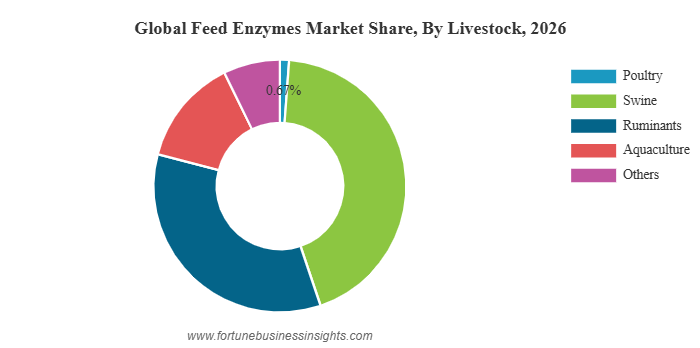
By Livestock:
Livestock categories include poultry, swine, ruminants, aquaculture, and others.
The poultry segment led, accounting for 43.14% share in 2026, driven by rising demand for poultry meat and eggs.
The swine segment is expected to grow at a CAGR of 5.07%, supported by high pork consumption in Asia and Europe.
Feed Enzymes Market Regional Outlook:
Asia Pacific
Asia Pacific dominated the market with USD 0.52 billion in 2025 and USD 0.54 billion in 2026. Growth is driven by expanding livestock and aquaculture industries in China, India, Japan, and Southeast Asia.
North America
North America is projected to reach USD 0.40 billion in 2025, supported by strong R&D infrastructure and sustainability-driven feed practices. The U.S. remains a major contributor due to large-scale poultry production.
Europe
Europe is expected to reach USD 0.32 billion in 2025, supported by stringent environmental regulations favoring sustainable feed additives. The region is projected to grow at a CAGR of 4.59%.
South America
South America is expected to emerge as the fastest-growing region, reaching USD 0.16 billion in 2025, driven by export-oriented livestock production in Brazil, Chile, and Argentina.
Middle East & Africa
The Middle East & Africa region is projected to grow steadily, with South Africa recording a CAGR of 3.96%, supported by expanding poultry and livestock farms.
Speak To Analysts: https://www.fortunebusinessinsights.com/enquiry/speak-to-analyst/feed-enzymes-market-114503
Competitive Landscape
Key Industry Players
The market exhibits a semi-consolidated structure with multinational and regional players competing through collaborations, partnerships, and new product launches to enhance bio-efficacy and market penetration.
List of Key Feed Enzymes Companies Profiled:
Novozymes A/S
Chr. Hansen A/S
DSM Nutritional Products AG
BASF SE
Kemin Industries, Inc.
Cargill, Inc.
Adisseo France S.A.S.
AB Enzymes GmbH
Amano Enzyme Inc.
BioResource International, Inc.
Key Industry Developments:
February 2025: Novonesis acquired DSM Firmenich’s Feed Enzymes alliance for approximately USD 1.53 billion.
September 2024: NOVUS International partnered with Ginkgo Bioworks to develop advanced feed enzymes.
August 2024: Adisseo partnered with Allozymes to develop enzymes for the European market.
October 2021: BASF and Cargill expanded collaboration in animal nutrition.
August 2020: ADM partnered with Auburn University to develop innovative poultry feed enzymes.
Future Scope:
The feed enzymes market is expected to expand steadily with advancements in precision nutrition, enzyme engineering, and species-specific formulations. Growing adoption of antibiotic-free animal production, stricter environmental regulations, and demand for sustainable livestock farming will drive long-term growth. Technological innovations in microbial fermentation and encapsulation are likely to reduce costs and improve efficacy. Emerging markets, aquaculture expansion, and customized enzyme blends will further create new revenue opportunities globally.
Ashwin Arora
Fortune Business Insights™ Pvt. Ltd.
+1 833-909-2966
sales@fortunebusinessinsights.com
Legal Disclaimer:
EIN Presswire provides this news content "as is" without warranty of any kind. We do not accept any responsibility or liability for the accuracy, content, images, videos, licenses, completeness, legality, or reliability of the information contained in this article. If you have any complaints or copyright issues related to this article, kindly contact the author above.
